Robustness improvements
It is important to ensure that your system remains robust to unexpected inputs. The table below summarises the issue types from Robustness evals.
| Issue | How to improve |
|---|---|
| Out-of-context reliability | Ensure knowledge-base and context hygiene before deployment |
| Out-of-scope / edge case queries | Integrate off-topic guardrails; instruct agents on expected behaviour when faced with edge cases; apply normalisation and handle aliases |
| Response consistency | Lower model temperature for deterministic tasks; pin model and prompt versions |
Tips on improving context reliability
- Ensure your knowledge base is always kept up-to-date. Integrate a reliable web search tool where needed.
- Instruct the model to abstain when the retrieved context does not answer the question, and give the user a next step.
- To reduce the chances of hallucinations, ensure the response is supported by a corresponding citation from the context.
Detecting retrieval failures
The metrics from Robustness evals can double as a detection measure. Run evals on your traffic at a regular cadence, and treat a score below your threshold as a signal that the context was not properly retrieved, or that the answer was not supported by it.
Use the results to tune:
- The number of sources retrieved, and the similarity threshold a source must clear before it is retrieved.
- Whether to fall back to web search when the knowledge base returns too little.
- How the retrieved sources are presented to the model.
Handling off-topic queries
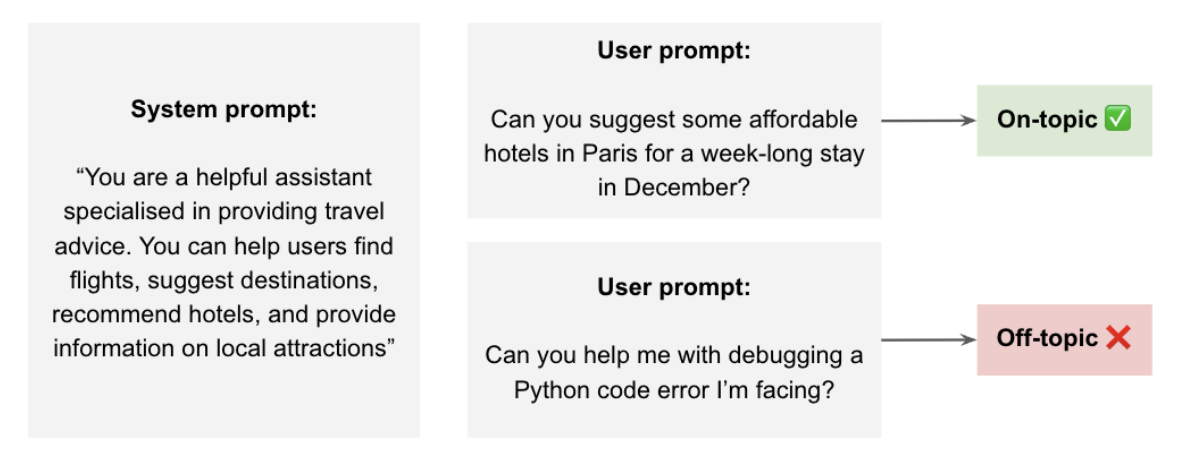
Off-topic guardrails keep AI systems within their intended purpose. Beyond filtering harmful content, detecting and filtering irrelevant queries helps maintain focus.
Use cases
- Public service chatbots that should only answer about a specific scheme or service.
- Internal assistants limited to a business process.
- Education or youth-facing AI systems with restricted topics.
- Retrieval systems that should not answer outside their knowledge base.
Detection approaches
- Zero-shot/few-shot classifiers to detect relevance against the system prompt. Suffers from lower precision — many valid queries are wrongly flagged off-topic.
- Custom topic classifier guardrails from Amazon Bedrock Guardrails or Azure AI Content Safety. Requires defining your own taxonomy of what is off-topic and/or providing custom training examples.
- GovTech's Off-Topic guardrail — a custom guardrail trained zero-shot on synthetic system-prompt and user-prompt pairs, scored against your system prompt. Available via the Sentinel API.
Actions
- Redirect the user to supported topics.
- Refuse unsupported topics politely.
- Ask a clarifying question when scope is ambiguous.
- Escalate repeated or suspicious attempts.
Code example
- General (cosine similarity)
- Sentinel
# Lightweight off-topic check: embed system prompt and user prompt,
# flag if cosine similarity falls below a threshold.
from sentence_transformers import SentenceTransformer, util

model = SentenceTransformer("jinaai/jina-embeddings-v2-small-en")

def is_off_topic(system_prompt: str, user_prompt: str, threshold: float = 0.35) -> bool:
    s, u = model.encode([system_prompt, user_prompt])
    return float(util.cos_sim(s, u)) < threshold
payload = json.dumps({
    "text": user_input,
    "messages": [{"role": "system", "content": SYSTEM}],
    "guardrails": {"off-topic": {"system_prompt": SYSTEM}},
})
response = requests.post(SENTINEL_BASE_URL, headers=HEADERS, data=payload)
if response.json()["results"]["off-topic"]["score"] > 0.7:
    return "I can only help with O-Level Maths questions."
Was this page helpful?