7.2 Common Agentic AI Workflow Patterns
7.2.1 Sequential Workflows
Sequential Pipeline
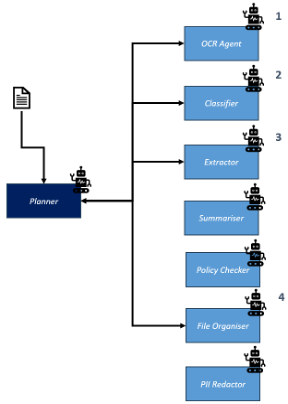
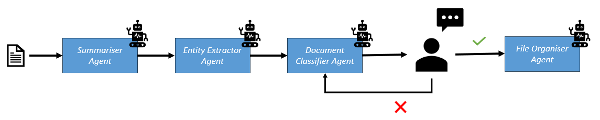
In a Sequential Pipeline, agents are arranged in a linear chain: Each agent’s output feeds directly into the next agent in order. This pattern is ideal when tasks must happen in a strict sequence, with each step building on the previous.

Planner-Decider
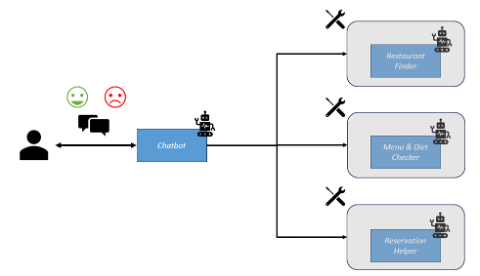
The Planner-Decider pattern features an orchestrator agent that plans or routes tasks to other agents best suited to execute them. One agent “decides” what needs to be done or who should do it, rather than a fixed chain. This often manifests as a handoff: the planner agent hands off control to a specialist agent mid-workflow when appropriate. It’s useful for dynamic task delegation and conditional workflows.
7.2.2 Parallel Workflows
Graph/DAG
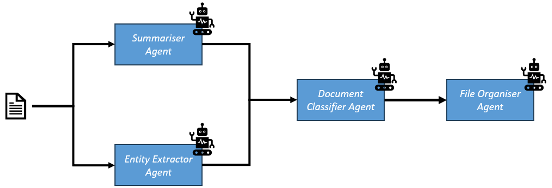
A Graph/DAG workflow generalises the pipeline by allowing branching and merging of agent paths. Instead of a single line, the control flow forms a directed acyclic graph (DAG): multiple agents can run in parallel on different subtasks, and their results can converge into subsequent agents. This pattern suits complex tasks where some steps can happen concurrently or where there are conditional branches.
7.2.3 Hierarchical Workflows
Supervisor-Worker
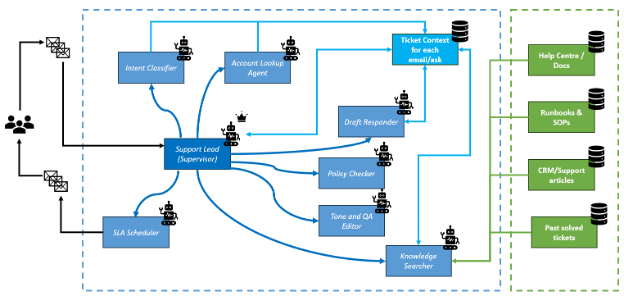
The Supervisor-Worker pattern involves a primary supervisor agent overseeing one or more worker agents. The supervisor manages the high-level goal, delegates sub-tasks to workers, and integrates or verifies their outputs. Unlike the planner-decider which is often hands off completely, a supervisor might remain in the loop, coordinating multiple workers and possibly performing a final review or decision. This resembles a manager and team relationship.
7.2.4 Collaborative/Swarm Workflows
Broadcast/Federated
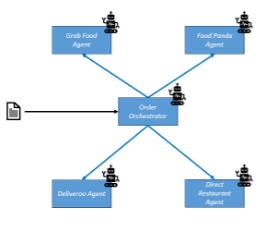
The Broadcast / Federated pattern fans out the same input to multiple peer agents at once, then fans in their independent results to a central Aggregator that selects, votes, or synthesises the outcome. Peers do not depend on each other’s outputs; each works in parallel on the identical request. This is ideal when you want coverage, redundancy, diversity, or speed (e.g., take the best price, the fastest acceptable answer, or a majority vote), without building inter-step dependencies like a pipeline or graph.
Agent-as-Tool
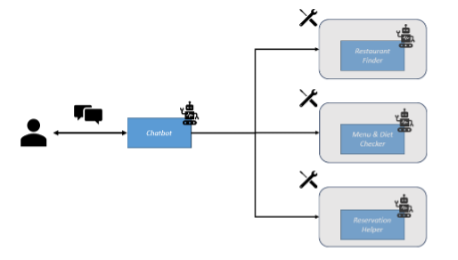
The Agent-as-Tool pattern treats one agent as a callable tool for another agent. In other words, a primary agent can invoke a secondary agent’s capabilities just like it would call an API or function, rather than handing off full control. This pattern effectively nests agents: the top-level agent remains in charge of the interaction, and whenever it needs a specific subtask done, it calls a subordinate agent (providing it some input) and waits for the result to incorporate into its own reasoning. This approach keeps a single coherent “thread of conversation” while still leveraging multiple specialised agents.
7.2.5 Human-in-the-Loop Integration
Human-in-the-loop (HITL) patterns let humans review, approve, or override an AI agent’s decisions before execution. In practice, this often means pausing an agent’s workflow at critical steps (e.g. before a risky tool call) so a person can intervene, or explicitly handing off control to a human for approval or additional input.
Approve or Reject
Pause the agent workflow before a critical step, such as an API call, to review and approve the action. If the action is rejected, you can prevent the agent workflow from executing the step, and potentially take an alternative action.
Review and Edit
A human can review and edit the temporary deliverable of the agent in the workflow. This is useful for correcting mistakes or updating the deliverable with additional information.

Review before Tool Calls
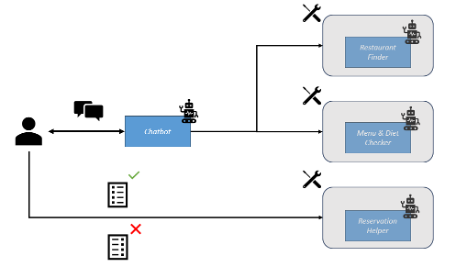
Similar to the “Review and Edit” pattern, but it’s to verify a tool that the agent is going to use. This is particularly critical in applications where the tool calls requested by the agent may be sensitive or require human oversight.
Multi-turn Conversation in a Multi-agent Setup
A multi-turn conversation involves multiple back-and-forth interactions between an agent and a human, which can allow the agent to gather additional information from the human in a conversational manner. This design pattern is useful in an LLM application consisting of multiple agents.