ORF framework overview
The Observability Requirements Framework is a risk-tiered telemetry specification for generative and agentic AI systems. It connects governance and technical controls to the operational evidence needed to show how a system behaved over time.
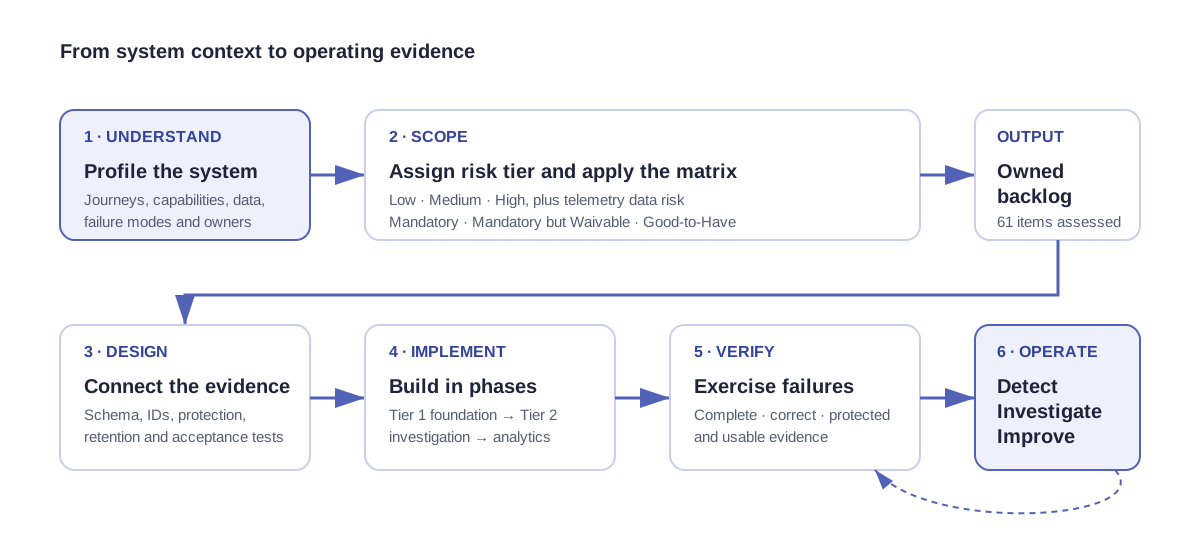
Framework structure
System risk tier
      ×
Telemetry priority tier
      ↓
Implementation obligation
      ↓
Selected metrics, logs, and traces
      ↓
Operational and assurance evidence
ORF defines 61 items:
| Priority | Items | Purpose |
|---|---|---|
| Tier 1 | 11 | foundational interaction, tool, misuse, error, and system records |
| Tier 2 | 31 | investigation, human oversight, reliability, security, privacy, identity, and change evidence |
| Tier 3 | 13 | deeper drift, UX, resilience, cost, safety, and governance analysis |
| Tier 4 | 6 | research-grade or evaluation-intensive outcome, hallucination, groundedness, fairness, and change comparison |
Six operational categories
| Code | Category | Risks addressed |
|---|---|---|
AGT |
Agent-Level Observability | incomplete reconstruction, runaway behaviour, silent regression |
PERF |
Agent Performance | performance drift, hallucination/ungroundedness, bias/fairness |
UX |
User Interaction & Behaviour | malicious use, untracked handover/override, experience gaps |
SYS |
System Performance, Health & Reliability | outage/partial failure, saturation, traffic spike, cost |
SEC |
Safety & Security Compliance | harmful output, privacy/classified leakage, privilege misuse, mutable audit trail |
GOV |
Product Lifecycle & Governance | uncontrolled change, ad hoc audit, weak post-incident learning |
Three signal types
- Log — a discrete structured record, such as a refusal, error, access, credential, or change event.
- Trace — connected spans/events showing causal or execution relationships across a query, task, retrieval, tool, or service chain.
- Metric — a numerical measure over an observation set or time window, such as rate, count, distribution, coverage, drift, or cost.
Many useful implementations derive metrics from canonical log or trace events. Keep a single source of truth so rates can be reconciled.
Relationship to controls
ORF evidence does not itself prevent harm. It supports controls by showing whether they were invoked and whether they worked.
Risk: runaway tool loop
  → Control: step limit + circuit breaker
  → ORF evidence: tool count, duration, retry lineage, terminal state
  → Use: real-time interruption, incident investigation, control assurance
The framework includes an ARC crosswalk. Some mappings are explicit in the ORF source, while others are thematic interpretations; retain that distinction when using ORF as control evidence.
Key interpretation rules
- System risk and telemetry priority are different dimensions.
- The matrix determines obligation; the phase chapters only recommend sequence.
- Data classification may require stricter telemetry handling regardless of system risk.
- A waiver accepts residual risk; it does not make the risk disappear.
- ORF is a baseline and may need system-specific additions.
- Framework metric definitions should remain stable across implementations.
Continue to Risk and requirements matrix or browse the requirement catalogue.